
Guide
Chimney flashing leaks: what to look for and who fixes it
Flashing is the metal that seals the joint where the chimney comes through the roof. When it fails, water runs in along the chimney and shows up as a stain on the ceiling or wall beside it, often during snowmelt.
By Moses Chimney. Updated .
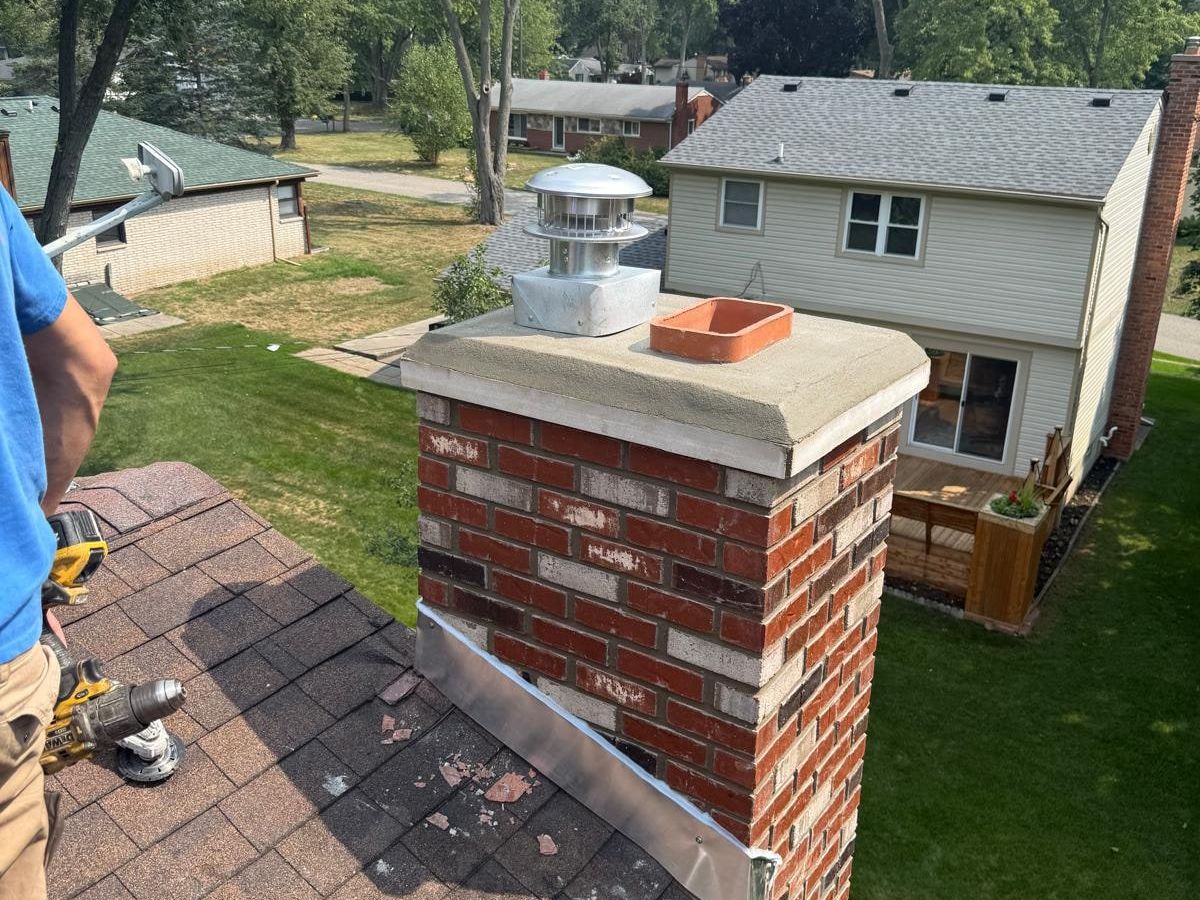
What flashing is
The roof moves and the chimney doesn't. Flashing covers the gap between them so water runs past the joint instead of into it.
On a brick chimney it's two layers. Step flashing is a row of L-shaped pieces woven in with the shingles, one piece per course, with one leg on the roof and one against the brick. Counterflashing is metal set into the mortar joints of the chimney and folded down over the step flashing.
The residential building code calls for flashing along a wall like this to be at least 4 inches high and 4 inches wide, and to send water away from the wall onto the roof. The counterflashing is what keeps water from getting behind the step flashing at the top.
The cricket on a wide chimney
A cricket, also called a saddle, is a small peaked roof built on the uphill side of the chimney. It splits the water coming down the roof and sends it around both sides, so it doesn't pond against the back of the chimney.
The International Residential Code calls for a cricket on the ridge side of any chimney more than 30 inches wide, measured across the slope, covered in sheet metal or the same material as the roof. On a wide chimney without one, the back of the chimney is the first place we check for a leak.
Why tar and caulk patches fail
The quick fix is a coat of roofing tar or caulk smeared over the joint. Maine Preservation calls these three- to five-year fixes at best.
A patch sits on top of the joint and does nothing about the flashing underneath. Once it cracks, water gets in behind it, and the tar hides where the water is coming from. Layers of tar around the base of a chimney usually mean the flashing under them was already failing when the first coat went on.
Signs of a flashing leak
Some you'll see inside, and some you can see from the ground with a pair of binoculars.
- A water stain on the ceiling or wall beside the chimney, or on the chimney breast itself
- Water marks or dark wood on the rafters or roof deck around the chimney in the attic
- A leak that only shows up in wind-driven rain from one direction, or when snow is melting
- Flashing that's rusted, bent, lifted away from the brick, or covered in tar
- Counterflashing that has pulled out of the mortar joint, often because the mortar around it has crumbled
A stain alone doesn't prove it's the flashing. Water can also get in through the crown, a missing cap or the brick, and run down to the same spot. Leak around the chimney: roofer or chimney company? goes through each source.
Michigan snow and ice
Snow piles up on the uphill side of a chimney all winter. As it melts, the water sits against the back of the chimney, right where the flashing and the cricket have to keep it out. The Great Lakes region averages about 42 freeze-thaw cycles a year, according to the University of Michigan's GLISA center. Water that gets into a gap and freezes opens it a little wider.
Michigan State University Extension explains that ice dams form when attic heat melts snow on the roof, and the water refreezes at the colder eaves. Water then backs up under the shingles and can leak into the attic. An ice dam leak shows up near the outside walls of the house. A leak that's right next to the chimney, during snowmelt, points more toward the flashing or the cricket.
Who fixes it
Flashing is shared ground between the roof and the chimney. Plenty of roofers do it well, and we do it too.
The counterflashing is set into the brick, so when the mortar joints holding it have failed, the joints need repointing before new counterflashing will hold. That part is masonry work. If the shingles around the chimney are worn out too, or you're about to reroof, the flashing is best done with the new roof so it's woven in with the new shingles.
A standard chimney inspection includes the flashing, along with the crown, the cap and the brick. We'll tell you where the water is getting in, and if the answer is the roof and not the chimney, we'll say so. Flashing, crown and masonry repairs are all on the chimney repair page.
Sources
- Maine Preservation: Leak-proof your chimney
- International Code Council: 2015 International Residential Code, R903.2.2 Crickets and saddles
- International Code Council: 2015 International Residential Code, R905.2.8.3 Sidewall flashing
- Michigan State University Extension: Tips to prevent ice dams from forming on your home
- Great Lakes Integrated Sciences and Assessments, University of Michigan: Freeze-thaw cycles
More guides
How much does a chimney inspection cost in Metro Detroit?
What an inspection, a cleaning and a camera inspection cost, what a Level 2 costs, and how repairs are priced.
How often should a chimney be cleaned?
Why the standard is a yearly inspection, when a chimney actually needs sweeping, and what to check before your first fire.
Leak around the chimney: call a roofer or a chimney company?
Where chimney leaks start, which ones a roofer handles, and which ones need a chimney company.
White stains and crumbling brick on your chimney
What white stains and flaking brick on a chimney tell you, and why sealing the brick usually isn't the fix.
Level 1, 2 or 3 chimney inspection: which one you need
What each inspection level covers, when you need a Level 2, and what a regular home inspection leaves out.
Rusted chase cover or missing chimney cap
What rust streaks under a chimney mean, why chase covers rust, and when a cap or cover needs replacing.
Birds chirping in your chimney: what to do about chimney swifts
Why you can't remove nesting chimney swifts, how long they stay, and what to do once they've gone.
After a chimney fire: what to do next
Signs of a chimney fire, what to do during one, and why a Level 2 inspection comes before the next fire.
Chimney damper stuck, rusted or missing
Throat and top-sealing dampers, the signs of a stuck or rusted damper, and what a repair involves.
Water heater venting alone into an old chimney
Why a water heater left alone in an old chimney can condense and spill, and why a sized liner is the usual fix.
Book an inspection or cleaning
Pick a day and a 3-hour arrival window online. If you'd rather talk it through, call (248) 266-9991.